
Floor lamps with dimmers: reviewing the usable range
Look at the settings people will use every day, as well as the lamp’s maximum output.
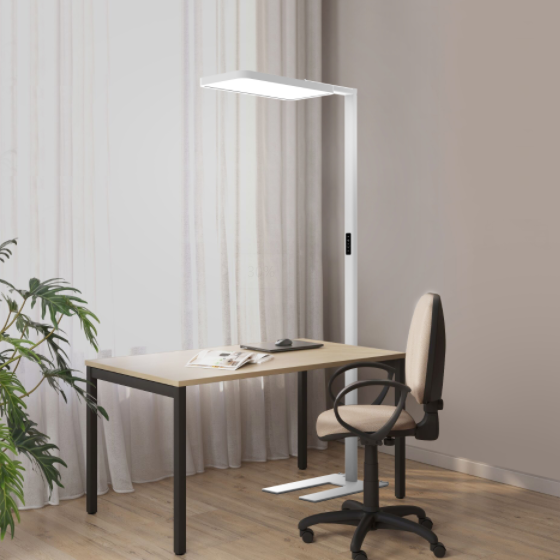
A floor lamp described as dimmable still leaves several practical questions open. Where is the control? How easy is it to reach a useful level? What happens when the lamp is switched back on? A sample review should connect these questions to the actual workspace.
1. Establish the lamp’s role
Identify whether the lamp is intended to support a desk, add light to a reading place or contribute to the wider room. Review it with the normal furniture and existing lighting. The choice of dimming settings should follow the task rather than a preferred percentage on a control.
Check the view from nearby seats as well as the intended user’s position. For room-specific considerations, the guide to dimmable floor-lamp applications provides a separate starting point.
2. Try the control from the working position
Locate the switch and dimmer while seated at the desk or chair. Check whether they remain reachable once the base, cable and furniture are in their final positions. Confirm which control interface is included in the proposed configuration.
Ask another user to adjust the sample without an explanation first. Note whether the direction, speed and result of an action are clear. If a remote or connected control is proposed, confirm what local controls remain available and what happens if the additional controller is unavailable.
3. Move through the useful range
Compare the upper setting required for the task with lower settings used at other times. Move slowly through the range and note abrupt steps, unexpected switching or visible instability. Try returning to the same useful level more than once.
Where a project needs measured dimming performance or flicker information, request the relevant evidence for the selected version. A user trial records usability and visible observations; it does not replace a specified measurement or test report.
4. Clarify what changes when you dim
Ask whether one control changes all of the light or whether separate channels can be adjusted. If separate control is required, test each channel and the combination. Record the supplied interface and its functions so these are not confused with another variant.
Confirm colour-temperature behaviour separately. Dimming and adjustable colour temperature should each have an explicit entry in the specification. Observe the sample through the selected settings and ask the supplier to explain any behaviour that differs from the brief.
5. Check switching and repeat use
Switch off at the normal control and then restart. Repeat after disconnecting and restoring power in accordance with the product instructions. Record whether the lamp recalls a setting or returns to a default, and whether this matches the intended use.
Keep the approved settings and sample identity with the order. If energy use is being compared, request input-power information at the relevant operating conditions; do not interpret a dimmer setting as an equal percentage reduction in electricity use.
A useful enquiry checklist
Prepare these details before discussing the proposed configuration:
- Task, room lighting and normal viewing positions
- Control location and seated access
- Useful upper and lower settings
- Dimming observations and required measured evidence
- Separate-channel and colour-temperature requirements
- Restart behaviour and approved configuration record
Choose a range people can use
A practical dimming review produces a clear control brief and a small set of repeatable checks. Use these alongside the lighting specification when confirming the final floor-lamp configuration.
For light-source and driver questions, see how dimmable LED floor lamps work. Confirm component and control compatibility for the exact configuration.